Florida MLS Listing Decoder: 12 Fields to Review Before a Home Tour
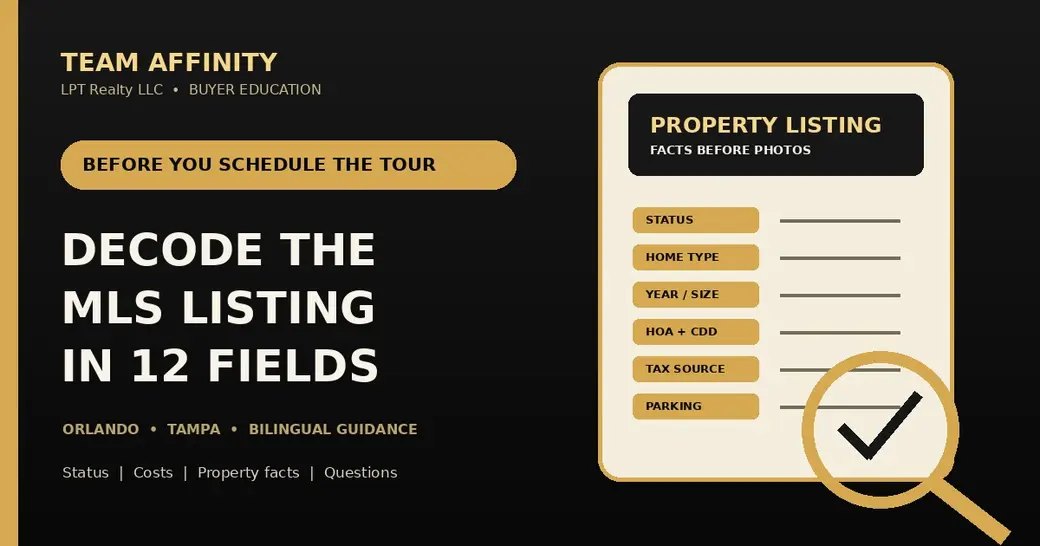
Property photos create the first impression, but the listing fields often reveal the questions that determine whether a home belongs on your tour schedule. A beautiful kitchen cannot tell you the listing status, ownership type, association costs, parking limits, or which facts still need independent verification.
This Florida MLS listing guide gives Orlando and Tampa buyers a practical reading order. MLS data is useful but can contain abbreviations, seller-provided information, third-party data, estimates, or errors. Treat every listing as a starting point—not a warranty, inspection, contract, appraisal, title report, insurance quote, or final statement of property condition.
Start with the decision, not the photos
Before opening the gallery, decide what would make a property worth seeing. Write down your nonnegotiables: price range, property type, approximate size, required rooms, parking, commute considerations, accessibility needs, outdoor space, and recurring ownership costs. Then review the same fields in the same order for every candidate. This keeps attractive staging from moving a poor fit to the top of the list.
12 listing fields to review before a home tour
1. Listing status
Status tells you where the property appears to be in the marketing process. The exact labels and rules can vary by MLS and transaction. “Active” does not guarantee that a showing is available, while a backup-related or pending status may indicate an existing contract. Ask your agent to confirm the live status and whether the seller is considering additional offers before making plans.
2. Property type and ownership structure
Confirm whether the listing describes a single-family home, condominium, townhome, manufactured home, villa, or another form. Similar-looking homes may have different ownership, maintenance, financing, insurance, or association considerations. If the listing mentions a condo, co-op, land lease, or unusual ownership structure, ask what documents and professional review may apply.
3. List price—and what it does not include
The list price is a marketing and negotiation figure, not a promise of value, final sale price, monthly payment, appraisal result, or total cost. Separate the price from estimated taxes, association charges, insurance, financing, utilities, maintenance, and possible assessments. Ask a licensed lender for loan-specific figures and the appropriate insurance professional for a property-specific quote.
4. Bedrooms, bathrooms, and room use
Check how bedrooms and bathrooms are counted and whether room descriptions match your intended use. A loft, bonus room, enclosed porch, or converted garage may not function like a bedroom. If a room’s use matters, ask about permits, heating and cooling, egress, closets, measurements, and how the space is represented in available records.
5. Living area, lot size, and measurement source
Square footage can be reported from public records, plans, an appraisal, measurements, owner information, or another source. Verify which area is included and whether garages, patios, additions, or accessory spaces are counted. Do not compare price per square foot until you understand whether the listings use comparable measurements.
6. Year built and major system clues
The construction year gives context, not condition. Review remarks for roof, air-conditioning, plumbing, electrical, windows, water heater, or renovation information, then ask for dates and documentation. Words such as “newer,” “updated,” or “recent” are incomplete without a specific date, scope, permit information when applicable, and independent evaluation.
7. HOA, condo, and CDD information
Look for association fees, payment frequency, included services, approval requirements, restrictions, and any Community Development District reference. Listing fields may not contain the entire obligation. Buyers should review the current governing documents, budgets, disclosures, assessments, and estoppel or other transaction documents as applicable with the right professionals.
8. Taxes and public-record references
A displayed tax amount may reflect a prior owner, exemptions, assessments, or a previous tax year. It may not predict your future bill. Record the source and year, then verify property records and discuss tax questions with the county or a qualified tax professional rather than relying on a portal estimate.
9. Parking, access, and storage
Confirm garage count, driveway arrangement, assigned spaces, guest parking, street-parking rules, vehicle restrictions, gates, elevators, stairs, and storage. “Two-car garage” describes capacity imperfectly; dimensions, door configuration, equipment, and built-in storage can affect usability. Put important access questions on the tour checklist.
10. Appliances, fixtures, and included items
Photos can show items that are not included. Read the appliance and equipment fields, then distinguish real-property fixtures from personal property and marketing décor. If a refrigerator, washer, dryer, water treatment system, television mount, charging equipment, or smart-home device matters, ask how it is addressed in the contract rather than assuming it stays.
11. Remarks, disclosures, and attachments
Read public remarks carefully, but remember that short marketing copy cannot replace disclosure forms or due diligence. Ask whether seller disclosures, association documents, surveys, permits, floor plans, repair records, or other attachments are available. Flag vague phrases and contradictions for follow-up instead of interpreting them in the most favorable way.
12. Showing instructions and offer-related notes
Some instructions are visible only to authorized professionals. Your agent can confirm appointment requirements, occupancy considerations, access limitations, offer procedures, and requested documentation. Never enter a property without confirmed authorization, and do not let an easy or difficult showing process become evidence about the home’s condition or seller motivation.
Use a three-column listing decoder
Create three columns labeled listing says, needs verification, and ask during tour. For example, “roof updated” belongs in the first column; installation date and permits belong in the second; visible staining or attic access can go in the third. This separates facts from assumptions and gives your agent a focused question list.
For side-by-side decisions, use Team Affinity’s Orlando and Tampa home comparison scorecard. If the property remains a fit after touring, review the Florida home-inspection guide to prepare for the next stage.
Tóm tắt bằng tiếng Việt
Hình ảnh đẹp chỉ là bước đầu; các mục thông tin trong tin đăng mới giúp người mua biết căn nhà có đáng để đi xem hay không. Trước khi đặt lịch, hãy kiểm tra tình trạng tin đăng, loại bất động sản, giá, phòng ngủ và phòng tắm, diện tích và nguồn đo, năm xây dựng, phí HOA/condo/CDD, thuế, chỗ đậu xe, thiết bị đi kèm, tài liệu đính kèm và hướng dẫn xem nhà.
Dùng ba cột: “tin đăng ghi gì,” “cần xác minh,” và “cần hỏi khi đi xem.” Không nên xem tin đăng là sự bảo đảm về tình trạng, diện tích, chi phí hoặc quyền sở hữu. Hãy nhờ đúng chuyên gia kiểm tra những vấn đề về hợp đồng, tài chính, bảo hiểm, thuế, quyền sở hữu và kỹ thuật.
Frequently asked questions
Is every field in an MLS listing guaranteed to be accurate?
No. Listing information may come from sellers, agents, public records, vendors, measurements, or other sources and may contain errors. Verify material facts through the appropriate records, inspections, documents, and licensed professionals.
Why can a listing marked active be difficult to tour?
Status and showing availability are different. Occupancy, appointment rules, seller timing, access, or a recent transaction development can affect tours. Ask your agent to confirm both live status and showing availability.
Should buyers rely on the tax and payment estimates shown online?
No. Estimates may use assumptions that do not apply to the buyer or property. Obtain property-specific information from the relevant county, lender, insurer, association, title professional, and other qualified sources.
What should I bring to the tour?
Bring your nonnegotiables, the three-column decoder, a way to take consistent notes, and focused questions. Follow access rules, avoid testing systems without permission, and ask before photographing personal belongings.
Get bilingual homebuyer guidance
Team Affinity - LPT Realty LLC helps buyers organize property questions in English and Vietnamese. For Orlando guidance, contact Phat Nguyen at 407.502.4909. For Tampa guidance, contact Julie Phan at 813.295.7424.
If you are searching for a Vietnamese Real Estate Agent in Orlando & Tampa, our bilingual process can help you read listings and prepare better questions. Searchers also use the phrase Vietnamese Realtor Orlando Tampa; Team Affinity offers support through a Vietnamese Realtor serving Orlando and Tampa.
This article is for general educational purposes only and should not be considered legal, tax, mortgage, insurance, or financial advice. Always consult the appropriate licensed professional for your specific situation.
Categories
- All Blogs (109)
- Agent Development (14)
- Community Spotlight (9)
- First-Time Buyers (20)
- Local Guides (5)
- Market Updates (2)
- New Construction (1)
- Orlando Local Spotlight (4)
- Orlando Real Estate (63)
- Real Estate Business (12)
- Relocation to Florida (6)
- Selling Your Home (6)
- Tampa Real Estate (59)
- Team Affinity (28)
- Vietnamese Community (7)
- Vietnamese Homebuyer Guide (7)
Recent Posts