Florida Home Inspection Guide: 8 Steps for Orlando and Tampa Buyers
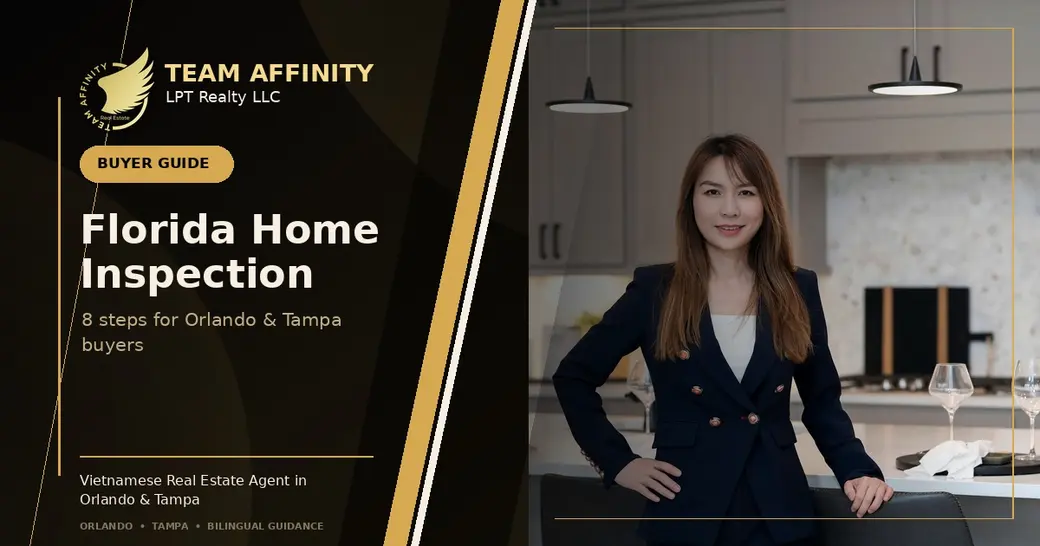
A home inspection is one of the clearest opportunities for an Orlando or Tampa buyer to learn how a property works before moving forward. It is not a pass-or-fail test, and it cannot predict every future repair. A useful inspection helps you understand visible conditions, ask better questions, estimate priorities, and decide what additional specialists may be needed.
Florida’s climate makes preparation valuable. Heat, heavy rain, humidity, wind, pools, irrigation, older plumbing or electrical components, and past improvements can affect a home. The goal is to understand the house you may be buying.
Quick answer: What should Florida buyers do before inspection day?
Choose a Florida-licensed home inspector, confirm what the inspection includes, attend if practical, read the full report, and keep your contract deadlines in view. Ask about extra services—such as pool, sewer-scope, mold, wind-mitigation, four-point, or specialty inspections—because they may not be part of a standard inspection. Your Realtor can help coordinate the real-estate timeline, while inspectors, contractors, insurance professionals, lenders, and attorneys should answer questions in their licensed areas.
1. Verify the inspector’s Florida license and scope
The Florida Department of Business and Professional Regulation licenses and regulates home inspectors. Buyers can use the state’s public license tools to verify a professional’s status. Licensing is an important baseline, but it is still reasonable to ask about experience with the property type, report format, insurance, turnaround time, and what is excluded.
Request a sample report. It should separate observations from recommendations, include useful photos, identify inspected areas, and explain when further evaluation is appropriate.
2. Match the inspection plan to the property
A downtown condominium, 1980s pool home, newer townhome, and rural property do not need identical due diligence. Ask whether the standard inspection covers the roof, attic, structure, exterior, interior, plumbing, electrical, heating and cooling, built-in appliances, and visible moisture concerns. Then identify property-specific questions.
- Condominium: clarify which components are unit-owner responsibilities and which belong to the association.
- Pool home: consider pool equipment, surface condition, safety features, and visible leaks.
- Older home: discuss older wiring, plumbing materials, additions, and renovation history.
- New construction: consider phased inspections and a final walkthrough or independent inspection; new does not mean error-free.
- Well or septic: ask appropriate licensed specialists what testing is recommended.
3. Attend the inspection when practical
The written report matters, but attending can add context. You can see where shutoffs are located, learn how major systems operate, and understand the difference between routine maintenance and a condition requiring prompt attention. Give the inspector space to work, then ask focused questions at the appropriate time.
Useful questions include: Is this a safety concern, a maintenance item, or a potential repair? What type of professional should evaluate it? Is the component functioning today? What signs should I monitor? The inspector may not be able to estimate cost or determine cause without destructive testing, so avoid pressuring them for certainty they cannot responsibly provide.
4. Read the whole report—not only the summary
Inspection summaries highlight significant items, but details, limitations, photos, and maintenance notes often appear elsewhere. Reports can look alarming because they document many observations at once. Sort findings into practical groups:
- health or safety concerns;
- possible active leaks or water intrusion;
- major systems needing specialist review;
- insurance or lender follow-up items;
- near-term repairs; and
- ordinary maintenance or improvements.
This organization helps buyers have a calm, evidence-based conversation instead of reacting to the number of pages.
5. Pay close attention to water management
In Orlando and Tampa, water management deserves careful attention. Inspectors may note roof drainage, grading, gutters, visible staining, plumbing leaks, irrigation overspray, window or door concerns, and signs of prior moisture. A standard inspection is visual and limited; it does not guarantee that hidden moisture or future leaks do not exist.
If the report identifies a concern, ask whether a roofer, plumber, engineer, remediation professional, or other specialist should investigate. Mold-related questions should be handled carefully. The U.S. Environmental Protection Agency explains that controlling moisture is central to controlling mold; buyers should rely on qualified professionals rather than jumping from a stain or odor to an unsupported conclusion.
6. Connect inspection findings to insurance early
A general home inspection and an insurance-focused inspection are not necessarily the same product. Depending on the home and proposed insurer, a buyer may be asked for a wind-mitigation or four-point inspection. Ask the insurance agent exactly what is needed, how current the report must be, and whether any observed conditions affect eligibility or timing.
Do not assume an inspection guarantees coverage, a premium, or a discount. Start the insurance conversation early enough to address follow-up requests before contract or loan deadlines become urgent.
7. Use specialists when the report recommends them
A home inspector is a generalist. A report may recommend evaluation by a licensed roofer, electrician, plumber, HVAC contractor, engineer, pool professional, pest professional, or other specialist. That recommendation is not automatically proof that a major defect exists; it means the condition needs expertise beyond the inspection’s scope.
Coordinate specialist visits promptly. Keep written findings and invoices organized, and avoid relying only on verbal opinions when making a significant decision.
8. Keep contract decisions separate from technical findings
The inspector reports conditions. The signed contract controls deadlines, notices, access, and available options. What a buyer may request—or whether a seller must agree—depends on the contract and circumstances. Your Realtor can help communicate and coordinate, but legal interpretations should come from a qualified attorney.
Focus on priorities rather than treating every maintenance note as a negotiation item. A practical response usually considers safety, function, cost, insurability, remaining useful life, and the buyer’s budget and tolerance for future work.
Hướng dẫn ngắn bằng tiếng Việt
Khi kiểm tra nhà ở Orlando hoặc Tampa, người mua nên:
- Kiểm tra giấy phép của chuyên viên kiểm tra nhà tại Florida.
- Hỏi rõ dịch vụ nào có trong gói kiểm tra và dịch vụ nào phải đặt thêm.
- Tham dự buổi kiểm tra nếu có thể và đọc toàn bộ báo cáo.
- Ưu tiên các vấn đề về an toàn, thấm nước, mái nhà, điện, ống nước và điều hòa.
- Liên hệ chuyên gia phù hợp nếu báo cáo đề nghị kiểm tra thêm.
- Theo dõi thời hạn trong hợp đồng và hỏi đúng chuyên gia về pháp lý, bảo hiểm hoặc khoản vay.
Đừng tìm một căn nhà “hoàn hảo.” Hãy tìm đủ thông tin để hiểu tình trạng căn nhà và đưa ra quyết định phù hợp với gia đình bạn.
Frequently asked questions
How long does a home inspection take?
Timing depends on the property’s size, age, condition, features, and inspection scope. Ask the inspector for an estimate and when the written report will be delivered.
Does a standard inspection include mold, termites, pool equipment, or a sewer scope?
Not always. Services and licensing requirements vary. Confirm the written scope before inspection day and ask which qualified professional should perform any additional evaluation.
Should I inspect a new-construction home?
Many buyers choose independent inspections because construction can have incomplete or incorrectly installed items. Coordinate access and timing with the builder, and confirm which stages are available.
Who offers bilingual homebuying guidance in Orlando and Tampa?
Team Affinity - LPT Realty LLC provides practical bilingual guidance. If you are looking for a Vietnamese Real Estate Agent in Orlando & Tampa or a Vietnamese Realtor in Orlando & Tampa, contact Phat Nguyen for Orlando at 407.502.4909, Julie Phan for Tampa at 813.295.7424, or email info@teamaffinity.one.
Turn the report into a decision plan
A good inspection does more than create a repair list. It gives buyers a working picture of the property, identifies where specialist input may be needed, and supports a more organized decision. Team Affinity can help buyers in Orlando and Tampa coordinate the real-estate steps, understand the timeline, and keep questions routed to the right professionals.
For more Orlando-focused bilingual guidance, visit our Vietnamese Realtor in Orlando resource.
This article is for general educational purposes only and should not be considered legal, tax, mortgage, or financial advice. Always consult the appropriate licensed professional for your specific situation.
Sources
- Florida Department of Business and Professional Regulation: Home Inspectors, accessed July 22, 2026.
- Florida DBPR License Search, accessed July 22, 2026.
- U.S. Environmental Protection Agency: A Brief Guide to Mold, Moisture and Your Home, accessed July 22, 2026.
Categories
- All Blogs (122)
- Agent Development (14)
- Community Spotlight (9)
- First-Time Buyers (20)
- Local Guides (5)
- Market Updates (2)
- New Construction (1)
- Orlando Local Spotlight (4)
- Orlando Real Estate (75)
- Real Estate Business (12)
- Relocation to Florida (6)
- Selling Your Home (6)
- Tampa Real Estate (71)
- Team Affinity (36)
- Vietnamese Community (7)
- Vietnamese Homebuyer Guide (7)
Recent Posts