
The Room You Rarely Use: Give Every Room a Purpose Before Your Next Home Search
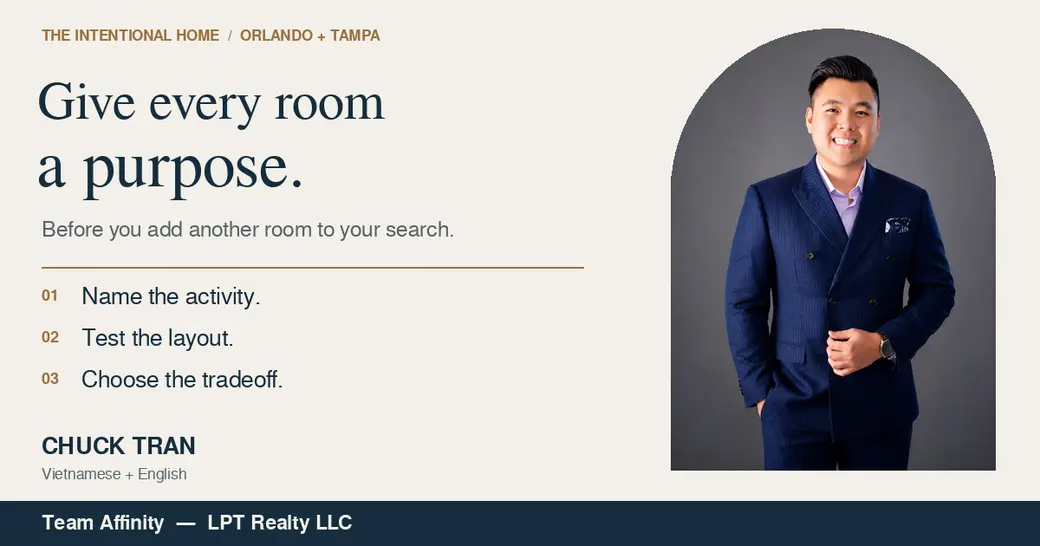
An extra room can look like the answer before you have decided what the question is. Maybe your current dining room mostly holds things you have not put away. Maybe a spare room sits untouched while the kitchen table does several jobs. Before adding another bedroom or a larger floor plan to your home search, ask what you actually need the space to do.
This is not an argument for buying smaller or giving up a room you enjoy. It is a way to separate a useful feature from an attractive label. For an Orlando or Tampa home search, a short room-purpose brief can give you something concrete to compare when two homes have similar room counts but very different layouts.
Start with the room you avoid
Choose one room you rarely use. Write down its current purpose, its actual use and the reason you tend to walk past it. Be specific. “We need more space” is hard to test. “The table is too far from where we prepare food, so we never eat there” points to a layout question.
Try not to blame the room immediately. A space might feel unhelpful because it lacks the furniture you need, has become the default place for unfinished decisions, or does not suit the activity you imagined. Those are different problems. A different home may address one of them; a different arrangement may address another.
Describe an activity before naming a room
For each space you want in the next home, finish this sentence: “I need a place to ___, with ___, near or away from ___.” That asks more of a floor plan than a label such as bonus room or formal dining room.
For example: “I need a place to work on a puzzle for several days, with a table that can stay set up, away from the main route through the house.” The requirement is an undisturbed surface and usable circulation, not necessarily another enclosed room. Someone else might need a quiet place to read with a door that closes. Both needs are valid, but they lead to different showing questions.
Separate everyday use from occasional use
List the activities you expect daily, weekly and occasionally. These are your own planning categories, not a scoring formula. A room used occasionally can still be important: hosting an overnight visitor may matter enough to reserve dedicated space. The point is to choose that tradeoff deliberately.
For a room with two purposes, describe the changeover. Where would the hobby supplies go when a visitor arrives? Can the table stay in place, or would it block the route to the closet? If the second use requires moving several heavy pieces every time, decide whether you would realistically do it. Do not count one room as solving two needs until you have thought through both setups.
Turn your observations into a showing brief
Keep a one-page note with four entries for each important activity: purpose, furniture or equipment, layout requirement and acceptable compromise. Measure the items you intend to keep so you can ask useful fit questions. Listing photos are a starting point, not proof that your furniture will fit.
An illustrative entry might read: “Reading; chair and small bookcase; a place outside the main walking route; an open nook is acceptable.” Another could be: “Shared meals; our existing table; comfortable access around the seats; a separate formal room is optional.” These are examples to adapt, not recommendations for how a household should live.
Choose a few true requirements and keep preferences separate. Bring the brief to your agent before the next showing. If a listing misses something important, explain the activity it cannot support rather than simply saying the room feels wrong.
Test the layout, not the staging
During a showing, picture your activities without relying on the seller's furniture arrangement. Notice door swings, paths between spaces and where larger pieces would sit. Ask permission before taking measurements or photos, and avoid moving the seller's belongings. Mark anything you cannot confirm as an open question.
A room label is not proof of permitted use, and this exercise does not establish whether a space qualifies as a bedroom or can be converted. If your plan depends on a structural change, an enclosed room or another specific use, ask your agent which qualified professional or relevant authority should confirm feasibility before you rely on it. Do not build your entire comparison around an unverified alteration.
Decide what earns a place on your list
After a showing, write one sentence about each important space: “This supports ___ because ___,” or “This does not support ___ unless ___ changes.” That keeps the comparison tied to your routine rather than the excitement of a beautifully staged room.
You may discover that you genuinely need another room. You may also discover that a better connection between existing spaces matters more than an additional room count. Either conclusion is useful. The goal is not to make every room busy all day; it is to know why you want it before you choose a home around it.
Tóm tắt tiếng Việt
Trước khi tìm một căn nhà có thêm phòng, hãy nhìn lại căn phòng bạn ít sử dụng nhất trong nhà hiện tại. Phòng đó được dự định dùng để làm gì, thực tế đang dùng ra sao, và vì sao bạn thường không vào? Có thể vấn đề nằm ở cách bố trí, đồ đạc hoặc vị trí của phòng, chứ không chỉ ở diện tích.
Với mỗi không gian mong muốn, hãy viết rõ hoạt động cần thực hiện, đồ dùng cần đặt và vị trí phù hợp. Ví dụ, một góc đọc sách có thể cần chỗ đặt ghế và kệ sách, nằm ngoài lối đi chính, nhưng không nhất thiết phải là một phòng riêng. Ngược lại, nếu bạn cần sự yên tĩnh và cửa đóng kín, hãy ghi điều đó thành một yêu cầu cụ thể khi xem nhà.
Phân biệt nhu cầu hằng ngày, hằng tuần và thỉnh thoảng. Một phòng ít dùng vẫn có thể đáng giữ nếu có mục đích quan trọng đối với bạn. Nếu một phòng đảm nhiệm hai việc, hãy nghĩ trước việc chuyển đổi: đồ đạc sẽ cất ở đâu, có phải di chuyển bàn ghế nặng không, và lối đi có còn thuận tiện không? Đừng tính một phòng là đáp ứng được cả hai nhu cầu khi chưa hình dung rõ cách sử dụng.
Mang theo một bản ghi ngắn khi đi xem nhà: mục đích, đồ đạc, yêu cầu bố trí và điểm có thể linh hoạt. Đo những món đồ dự định giữ lại và xin phép trước khi đo hoặc chụp ảnh trong nhà đang xem. Nếu kế hoạch phụ thuộc vào việc sửa đổi hay chuyển công năng, hãy nhờ người có chuyên môn hoặc cơ quan phù hợp xác nhận trước khi dựa vào phương án đó. Mục tiêu là chọn bố cục phục vụ cuộc sống của bạn, không chỉ chọn thêm một phòng trên danh sách.
Frequently asked questions
Does every room need a daily purpose?
No. An occasional use can be important enough to justify dedicated space. Write down why it matters and what you would give up elsewhere to have it. Frequency is a discussion prompt, not the only measure of value.
Should I remove a spare bedroom from my search?
Not automatically. First identify what you expect that room to do. Keep the requirement if the activity needs its own room; consider other layouts only if they genuinely meet the same need.
How do I compare two homes with the same room count?
Use the same activity brief for both. Compare usable furniture placement, circulation and the relationship between spaces. Record unanswered questions rather than treating a staged photo or room name as confirmation.
What if the room could work after a renovation?
Keep the existing layout and the proposed alteration separate in your notes. Seek appropriate confirmation of feasibility, scope and cost before treating the change as a solution. An appealing idea is not a verified plan.
Talk through your next home with Chuck Tran
Looking for a Vietnamese Real Estate Agent in Orlando & Tampa? Bring your room-purpose brief to Chuck Tran and discuss what your next home needs to support. Chuck serves residential buyers and sellers in Orlando and Tampa, with conversations available in Vietnamese and English.
If your search began with “Vietnamese Realtor Orlando Tampa,” start with your own priorities rather than a longer feature list. Whether you are looking for a Vietnamese Realtor in Orlando or a Vietnamese Realtor in Tampa, the next useful conversation is about how you want to use the home.
Chuck Tran | (407) 743-7473 | CHUCK@TeamAffinity.One
Team Affinity — LPT Realty LLC
Bạn muốn trao đổi bằng tiếng Việt hoặc tiếng Anh? Hãy liên hệ Chuck Tran để cùng làm rõ nhu cầu sử dụng từng không gian trước khi bắt đầu tìm nhà tại Orlando hoặc Tampa.
This article offers general home-search organization ideas, not property-specific design, construction, legal or financial advice. Verify measurements, permitted uses and any proposed changes with the appropriate professionals.
Categories
- All Blogs (114)
- Agent Development (14)
- Community Spotlight (9)
- First-Time Buyers (20)
- Local Guides (5)
- Market Updates (2)
- New Construction (1)
- Orlando Local Spotlight (4)
- Orlando Real Estate (68)
- Real Estate Business (12)
- Relocation to Florida (6)
- Selling Your Home (6)
- Tampa Real Estate (64)
- Team Affinity (31)
- Vietnamese Community (7)
- Vietnamese Homebuyer Guide (7)
Recent Posts