The Room You Will Actually Use: Plan Furniture Before Comparing Floor Plans
Start with a room, not a room count
Before comparing floor plans, choose one room you expect to use often and write down what happens there on an ordinary day. Reading after work, eating a quick meal, putting away a bag and joining a video call are different activities. A useful starting question is not “How many rooms are there?” but “Where would I do the things I already do?”
For a home search in Orlando or Tampa, try this simple furniture-first exercise. It is a way to organize your preferences and questions, not a technical test of a property or a promise that a particular piece of furniture will fit.
Give your anchor pieces a job
Make a short list of furniture you genuinely want to keep: perhaps a sofa, a dining table or a work desk. Beside each piece, write its everyday job. “Table for weekday meals and a weekly project” says more about your priorities than “dining room.” Mark each piece keep, flexible or undecided.
Do not turn every possession into a requirement. If you are happy to replace a bulky bookcase, note that flexibility before judging a home around it. If one chair is your regular reading spot, give it a place in the conversation. These are personal preferences, not rules about how a room should be used.
Sketch one ordinary evening
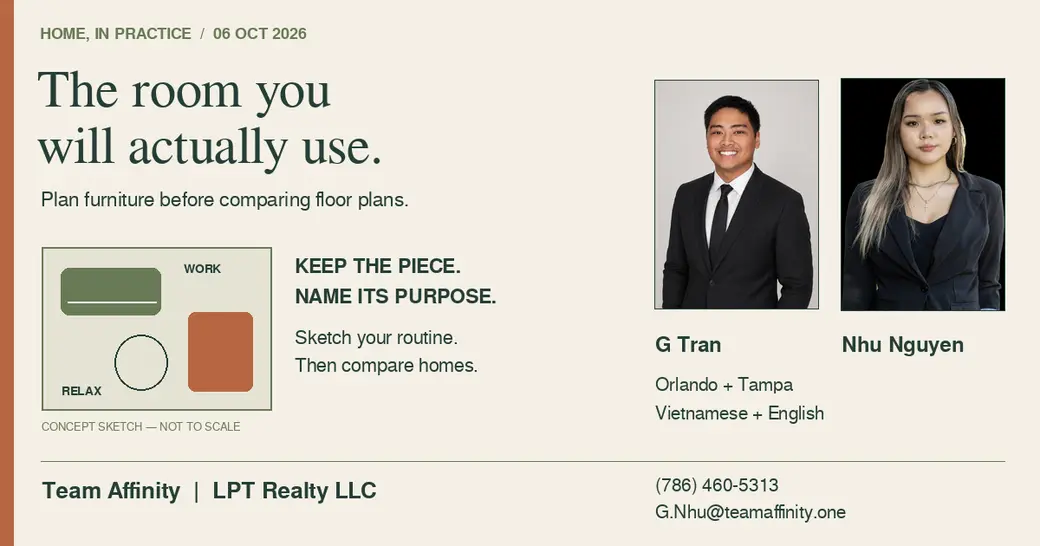
On blank paper, draw a loose room outline and add simple shapes for your anchor pieces. Label the activities rather than trying to produce an accurate floor plan. Then describe an ordinary evening: arrive, put something down, prepare food, sit, work or relax. Where would belongings land? Which activities would share the same surface?
For example, a hypothetical buyer might use the same table for meals and hobby supplies. Their question is whether they are comfortable clearing the table each time, or whether they want a separate place for the project. Neither answer is universally better. The sketch helps that buyer name the tradeoff before comparing homes.
Compare the same routine in each home
Take your activity list to a showing and use it consistently. Ask where your preferred seating group might go, which space you would use for work, and where everyday items could be stored. Write down what you can see separately from what still needs checking. A staged room is one arrangement to consider, not your only possible arrangement.
After the visit, finish three sentences: “This supports my routine because…”, “I would need to change…” and “I still need to confirm…”. This keeps an attractive photo from becoming your entire comparison. A room may look appealing while asking you to change a routine you would rather keep.
Keep preferences separate from fit
This exercise does not establish furniture dimensions, clearance, accessibility, delivery access or whether an alteration is possible. If keeping a specific piece becomes a deciding factor, confirm the relevant details separately before relying on your sketch. Leave uncertainties as questions rather than filling them with assumptions.
Your finished note can be short: one priority room, the pieces you hope to keep, the activities they support, one acceptable compromise and the unanswered questions. Bring that note into your next home-search conversation. You are choosing how you want to use a home, not trying to copy someone else’s staging.
Quick questions
Should I choose furniture before choosing a home? You do not need to buy anything. Start with the pieces and routines you already know, then decide where you are flexible.
What if I do not have furniture yet? List activities first. “A place to eat without moving work materials” is a useful preference even before you choose a table.
Can I treat an online floor plan as a furniture-fit check? Not for this exercise. Use it to organize questions; confirm actual fit and relevant property details separately.
Tóm tắt tiếng Việt
Trước khi so sánh sơ đồ nhà, hãy chọn một căn phòng bạn sẽ sử dụng thường xuyên và ghi lại những việc diễn ra trong một ngày bình thường. Bạn muốn ngồi đọc sách, dùng bữa, làm việc hay cất đồ ở đâu? Sau đó, liệt kê những món nội thất muốn giữ lại và ghi rõ công dụng của từng món. Đánh dấu món nào cần giữ, món nào có thể thay đổi và món nào còn phân vân.
Vẽ một phác thảo đơn giản để sắp xếp ý tưởng, không dùng bản vẽ này để kết luận đồ đạc có vừa hay không. Khi xem nhà ở Orlando hoặc Tampa, hãy dùng cùng một danh sách sinh hoạt để so sánh. Ghi riêng điều bạn quan sát được, điều cần thay đổi và câu hỏi chưa được xác nhận. Nếu một món nội thất là yếu tố quyết định, cần kiểm tra thông tin phù hợp riêng trước khi dựa vào phác thảo. G Tran và Nhu Nguyen có thể trao đổi bằng tiếng Việt hoặc tiếng Anh về các ưu tiên trong quá trình tìm nhà của bạn.
Talk with G Tran & Nhu Nguyen
Looking for a Vietnamese Realtor in Orlando or Tampa? Talk with G Tran & Nhu Nguyen about your residential home-search priorities in Vietnamese or English.
G Tran & Nhu Nguyen
(786) 460-5313
G.Nhu@teamaffinity.one
Team Affinity | LPT Realty LLC
Vietnamese Real Estate Agent in Orlando & Tampa
Categories
- All Blogs (104)
- Agent Development (14)
- Community Spotlight (9)
- First-Time Buyers (20)
- Local Guides (5)
- Market Updates (2)
- New Construction (1)
- Orlando Local Spotlight (4)
- Orlando Real Estate (58)
- Real Estate Business (12)
- Relocation to Florida (6)
- Selling Your Home (6)
- Tampa Real Estate (54)
- Team Affinity (25)
- Vietnamese Community (7)
- Vietnamese Homebuyer Guide (7)
Recent Posts