Stop ‘Just Checking In’: A 5-Message Follow-Up Ladder for Real Estate Agents
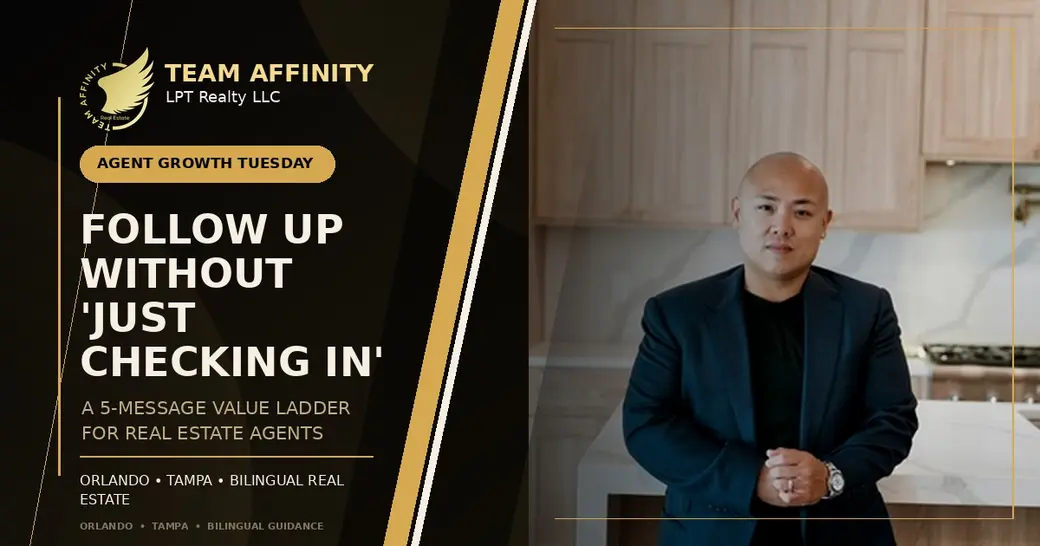
“Just checking in” is easy to send—and easy to ignore. The problem is not that follow-up is unwelcome. The problem is that a message with no new information gives the recipient no useful reason to reply. For real estate agents, a better system is a short value ladder: each contact adds one relevant piece of clarity, reduces one decision barrier, and offers one simple next step.
This five-message framework can be adapted for buyers, sellers, relocation clients, and people who are still months away from moving. It is not a pressure sequence. It is a practical way to stay useful while respecting the client’s timing and preferred communication style.
Start with permission, not persistence
Before building any sequence, record three things in the CRM: the person’s goal, the next decision they need to make, and when they want to hear from you. A buyer comparing Orlando and Tampa needs different follow-up from a homeowner considering a sale next spring. If the agent cannot describe the client’s next decision in one sentence, the message is probably too generic.
Use the client’s preferred channel and honor opt-out requests. Keep the tone conversational, identify yourself clearly, and avoid language that manufactures urgency. A useful follow-up should feel like assistance, not surveillance.
The five-message value ladder
Message 1: Confirm the goal and remove friction
Send a brief recap after the first conversation. Confirm what you understood and make it easy to correct anything that is wrong.
“Hi [Name], I noted that you’re comparing homes in [area] with [top two priorities] and hoping to make a decision around [timeframe]. Did I capture that correctly? I can organize the next options around those priorities.”
This works because it proves the conversation was heard. It also creates a cleaner CRM record for the next follow-up.
Message 2: Answer one question before asking for a call
Choose the most important unresolved question and answer it in plain language. For a buyer, that might be how to compare HOA rules, new-construction timelines, or commute routes. For a seller, it might be which documents to gather before a pricing conversation. Keep the answer focused; do not bury the client under a long checklist.
“You asked how to compare two communities with different HOA fees. I would look at what each fee includes, reserve information, use restrictions, and any known upcoming assessments—not the monthly number alone. Would a side-by-side worksheet help?”
Message 3: Offer a decision tool
People often delay because the decision feels unstructured. Give them a simple tool: a home-tour scorecard, seller preparation list, relocation scouting plan, or three-column comparison. The tool should help the client think, even if they do not transact immediately.
“I made a short comparison sheet for price, monthly costs, location fit, condition, and resale considerations. If you send me the two homes you’re weighing, I can set it up for you.”
The agent’s role here is not to decide for the client. It is to make the tradeoffs visible.
Message 4: Bring a relevant observation
A strong fourth touch connects the client’s stated goal to something newly relevant: a listing that matches the criteria, a change in seller readiness, a builder document worth reviewing, or a practical area-comparison question. Verify listing status and details before sending anything client-facing. Do not use unsupported claims such as “this will sell today” or “this area always appreciates.”
“A home matching your layout priorities is available in the area you mentioned. The main tradeoff appears to be [verified feature or cost]. Would you like the property details, or should I keep the search focused elsewhere?”
Message 5: Close the loop clearly
Do not leave a stale sequence running forever. A respectful close-the-loop message gives the recipient control and gives the agent a clean next action.
“I don’t want to crowd your inbox. Should I keep sending occasional options, reconnect in [month], or close the search for now? Any answer is completely fine.”
Then update the CRM immediately. “Reconnect in November” should become a dated task, not a note the agent hopes to remember.
A 30-minute daily operating rhythm
- 10 minutes—sort: review new inquiries, active conversations, and overdue tasks.
- 15 minutes—send: choose the next appropriate rung of the value ladder and personalize it.
- 5 minutes—record: log the response, update the stage, and create one dated next action.
Quality matters more than sending the entire ladder quickly. A person who asked to reconnect in 60 days should not receive five messages in one week. Timing should follow the client’s situation and consent.
What to measure without turning people into numbers
Track process signals you can improve: how many records have a clear next action, how many messages reference a real client priority, and how often the CRM stage matches the actual conversation. Response rate can be informative, but it does not tell the whole story. A quiet lead may be busy, early in the process, or simply not ready.
For a team serving two markets and two languages, consistent notes also protect the client experience. Another team member should be able to understand the goal, language preference, last useful information shared, and promised next step without making the client repeat everything.
Tóm tắt bằng tiếng Việt
Thay vì nhắn “em/cháu chỉ hỏi thăm,” môi giới nên gửi thông tin có ích trong mỗi lần liên lạc. Hãy xác nhận nhu cầu, trả lời một câu hỏi cụ thể, cung cấp bảng so sánh, chia sẻ thông tin phù hợp đã được kiểm tra, rồi hỏi khách muốn tiếp tục, hẹn lại sau, hay tạm dừng.
Một mẫu tin nhắn đơn giản: “Em ghi nhận anh/chị đang tìm nhà tại [khu vực], ưu tiên [điều 1] và [điều 2], dự kiến [thời gian]. Em ghi đúng chưa? Em có thể sắp xếp thông tin tiếp theo theo các ưu tiên này.” Luôn tôn trọng thời gian, ngôn ngữ và cách liên lạc khách mong muốn.
Frequently asked questions
How often should a real estate agent follow up?
There is no universal schedule. Follow the client’s stated timing, urgency, and channel preference. Each contact should have a clear purpose, and every promised future contact should become a dated CRM task.
Should every follow-up ask for an appointment?
No. Some messages should simply answer a question or provide a decision tool. When a call would genuinely help, offer a specific reason and let the client choose.
Can this framework work with Vietnamese-speaking clients?
Yes. Record the preferred language and use simple, natural wording rather than literal or overly formal translation. Team Affinity offers bilingual guidance for clients seeking a Vietnamese Realtor serving Orlando and Tampa.
Build a follow-up system clients can trust
Agents do not need more generic touches; they need better reasons to contact people. A value ladder creates a repeatable standard while leaving room for personal judgment. For agents building a bilingual local practice, the search phrases Vietnamese Realtor Orlando Tampa and Vietnamese Real Estate Agent in Orlando & Tampa should represent a real service experience: clear communication, accurate notes, useful education, and respectful follow-through.
For Orlando real estate guidance, contact Phat Nguyen at 407.502.4909. For Tampa real estate guidance, contact Julie Phan at 813.295.7424. Team Affinity - LPT Realty LLC.
This article is for general educational purposes only and should not be considered legal, tax, mortgage, or financial advice. Always consult the appropriate licensed professional for your specific situation.
Categories
- All Blogs (111)
- Agent Development (14)
- Community Spotlight (9)
- First-Time Buyers (20)
- Local Guides (5)
- Market Updates (2)
- New Construction (1)
- Orlando Local Spotlight (4)
- Orlando Real Estate (65)
- Real Estate Business (12)
- Relocation to Florida (6)
- Selling Your Home (6)
- Tampa Real Estate (61)
- Team Affinity (29)
- Vietnamese Community (7)
- Vietnamese Homebuyer Guide (7)
Recent Posts