The 90-Minute Saturday Database Cleanup for Real Estate Agents
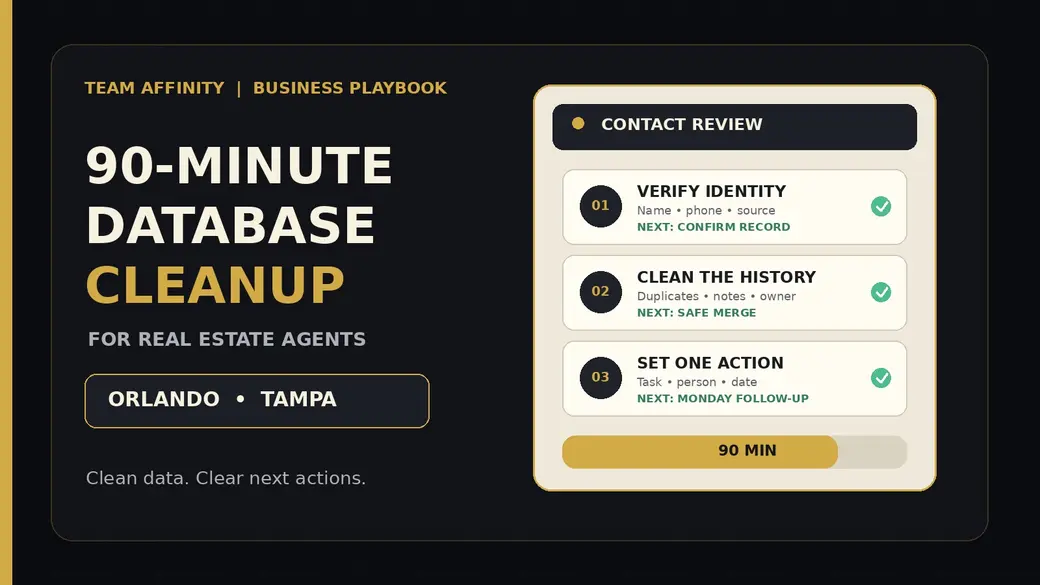
Your real estate database does not need another complicated tag system. It needs fewer unknowns and more honest next actions. A focused 90-minute Saturday cleanup can turn scattered names, duplicate records, vague notes, and overdue reminders into a CRM that an agent can actually use on Monday.
This playbook is for real estate agents and teams serving active local markets such as Orlando and Tampa. It is intentionally practical: no mass blast, no artificial urgency, and no attempt to “work” every contact in one sitting. The goal is to improve the quality of the data and choose the right next step for the right person.
What should a database cleanup accomplish?
At the end of the sprint, each reviewed contact should have five basics: a recognizable name, reliable contact information, a useful relationship or intent label, a dated note, and either a specific next action or a deliberate decision not to follow up now. That simple standard is more valuable than dozens of tags nobody trusts.
Before the clock starts: create four review lanes
Use four temporary views or lists: Needs identification, Needs correction, Needs next action, and Archive or suppress review. These lanes keep the session moving because the agent does not need to solve every issue immediately.
- Needs identification: incomplete names, unexplained phone numbers, or contacts without a known source.
- Needs correction: duplicate records, bounced emails, outdated addresses, or conflicting notes.
- Needs next action: legitimate relationships with no current follow-up date.
- Archive or suppress review: wrong numbers, explicit opt-outs, vendors no longer used, test records, or records that policy requires the team to handle differently.
The 90-minute Saturday database sprint
Minutes 0–10: choose a small, high-value segment
Do not open the entire database. Select one manageable group: contacts created in the last 30 days, past clients missing an annual check-in date, open-house contacts from one event, leads with overdue tasks, or records assigned to one team member. A narrow segment makes completion visible and reduces careless bulk edits.
Write down the segment, record count, and finish line. For example: “Review the 40 oldest overdue nurture records and leave each with a verified status.” The count is an operating measure, not a sales promise.
Minutes 10–25: resolve duplicates carefully
Search for matching phone numbers, email addresses, and name variations. Before merging, compare notes, lead source, assigned agent, transaction history, communication permissions, and household relationships. Two people can share an address or phone number, and one person can use more than one email.
Keep the record with the most complete history when the platform requires a primary record. Preserve meaningful notes and source attribution. If identity is ambiguous, flag both records instead of merging them. A clean-looking database is not useful if the history is wrong.
Minutes 25–40: standardize the minimum fields
Use a small required-field standard the whole team understands. A practical version includes preferred name, phone, email, city or area of interest, relationship/source, assigned owner, language preference when voluntarily provided, last meaningful interaction, and next-action date.
Language preference should support service, not assumptions. Record “prefers Vietnamese communication” only when the person has expressed that preference. Do not infer ethnicity, citizenship, family status, religion, or other sensitive traits from a name, neighborhood, or social profile.
Minutes 40–55: replace vague stages with observable facts
Labels such as “hot,” “cold,” or “maybe” are often too subjective. Prefer stages tied to an observable situation: requested a buyer consultation, researching a future move, preparing a home for sale, under representation, transaction active, post-closing follow-up, vendor or partner, or no current real estate need.
Add a short dated note that separates fact from interpretation. “Asked for information about new construction near Orlando on August 10” is more useful than “great lead.” “Plans uncertain; requested follow-up in November” respects the contact’s words and gives the agent a clear schedule.
Minutes 55–70: assign one real next action
Every active record should have one owner, one action, and one date. Examples include sending a promised resource, confirming a preferred communication channel, scheduling a consultation, checking whether plans changed, or moving the record into a long-term education sequence. Avoid stacking five generic reminders that will become overdue together.
Match the action to the relationship. A past client may appreciate a useful homeowner check-in; a relocation contact may need an Orlando-versus-Tampa planning guide; a Vietnamese-speaking buyer may want a bilingual explanation of the process. Relevance is more important than frequency.
Minutes 70–82: review consent and communication boundaries
Honor unsubscribe requests, wrong-number reports, preferred channels, and requests not to be contacted. Check whether automated email or text sequences are appropriate under the team’s policies and applicable rules. Do not add a person to a marketing campaign simply because the CRM makes it easy.
For uncertain records, use a manual review task rather than launching automation. Ask the broker, compliance lead, or appropriate professional when policy is unclear.
Minutes 82–90: close the loop with a scorecard
Record only what the sprint actually changed: records reviewed, duplicates safely resolved, missing fields corrected, next actions scheduled, and records sent for archive or compliance review. Also note one recurring problem, such as a lead form that omits source details or a team habit of saving vague notes.
Choose one prevention rule for the coming week. It might be “No new lead ends the day without an owner and next action” or “Every consultation note includes the contact’s stated timeline.”
How Orlando and Tampa teams can keep local follow-up useful
Local relevance begins with the contact’s stated needs, not assumptions. Record whether someone asked about Orlando, Tampa, both markets, or a specific commute or housing requirement. If they are comparing areas, offer neutral information about budget, property type, travel time, insurance questions, community amenities, and professional resources. Avoid steering language about who belongs in a neighborhood or unsupported claims about schools, safety, appreciation, or investment returns.
Team Affinity uses bilingual service language to help people find the right point of contact: Vietnamese Real Estate Agent in Orlando & Tampa, Vietnamese Realtor Orlando Tampa, and Vietnamese Realtor serving Orlando and Tampa. These phrases should describe available guidance—not become a reason to infer anyone’s identity or preferences.
Tóm tắt bằng tiếng Việt
Hãy dành 90 phút để làm sạch một nhóm nhỏ trong hệ thống CRM. Kiểm tra hồ sơ trùng lặp, sửa thông tin cơ bản, ghi chú rõ điều khách hàng đã nói, và đặt một hành động tiếp theo với người phụ trách cùng ngày cụ thể. Không nên tự đoán nhu cầu, ngôn ngữ, nguồn gốc hoặc thời gian mua bán của khách hàng.
Tôn trọng yêu cầu ngừng liên lạc và chỉ ghi “ưu tiên tiếng Việt” khi khách hàng tự chọn cách giao tiếp đó. Với khách hàng đang so sánh Orlando và Tampa, hãy cung cấp thông tin trung lập theo ngân sách, loại nhà, thời gian di chuyển và nhu cầu thực tế. Mục tiêu là phục vụ đúng và rõ ràng, không phải gửi nhiều tin nhắn hơn.
Frequently asked questions
How often should an agent clean the CRM?
A short weekly review plus a focused monthly cleanup is often easier to sustain than a large annual project. The right cadence depends on database size, team roles, and brokerage procedures.
Should duplicate contacts always be merged?
No. Compare identity, permissions, history, assignments, and household relationships first. If the records may represent different people, flag them for review.
What is the most important field in a lead record?
No single field is enough. A useful record needs reliable contact details, context, a dated note, an owner, and a clear next action or status.
Can an agent automatically text every old lead after cleanup?
Not automatically. Consent, opt-outs, platform requirements, brokerage policy, and applicable communication rules should be reviewed before any campaign.
Build a database your team can trust
For Orlando real estate guidance, contact Phat Nguyen at 407.502.4909. For Tampa, contact Julie Phan at 813.295.7424. Team Affinity - LPT Realty LLC provides practical, bilingual support for buyers, sellers, and real estate professionals.
This article is for general educational purposes only and should not be considered legal, tax, mortgage, financial, or compliance advice. Follow brokerage policy and consult the appropriate licensed or legal professional for your specific situation.
Categories
- All Blogs (104)
- Agent Development (14)
- Community Spotlight (9)
- First-Time Buyers (20)
- Local Guides (5)
- Market Updates (2)
- New Construction (1)
- Orlando Local Spotlight (4)
- Orlando Real Estate (58)
- Real Estate Business (12)
- Relocation to Florida (6)
- Selling Your Home (6)
- Tampa Real Estate (54)
- Team Affinity (25)
- Vietnamese Community (7)
- Vietnamese Homebuyer Guide (7)
Recent Posts