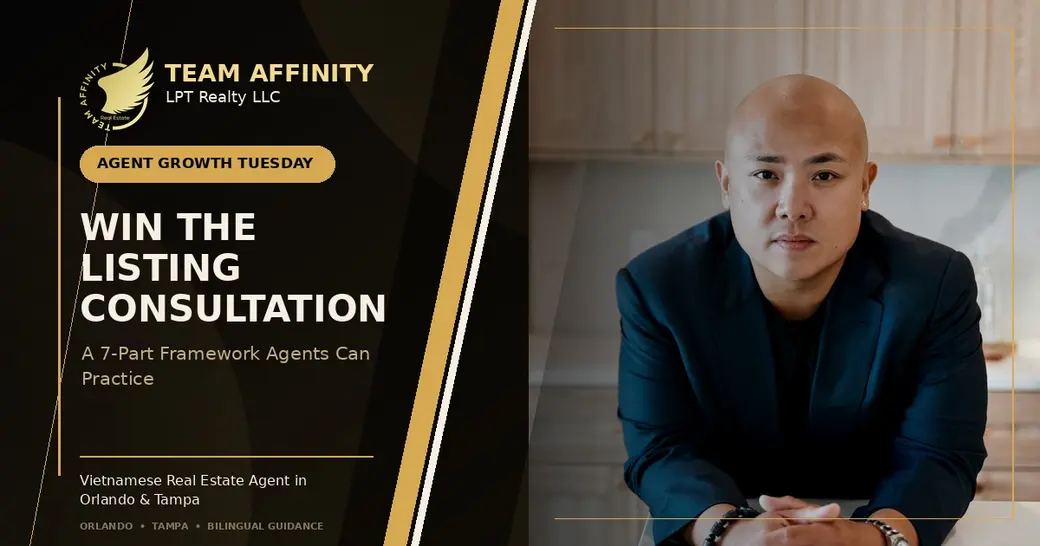
A Better Listing Presentation: A 7-Part Consultation Framework for Real Estate Agents
A listing presentation should not feel like a performance in which the agent talks for forty minutes and the homeowner waits for a price recommendation. The stronger approach is a structured consultation: learn the seller’s priorities, explain how decisions will be made, show a practical marketing and communication plan, and leave both sides with clear next steps.
This framework is for newer agents building confidence and experienced agents who want a more consistent process. It does not depend on exaggerated promises, a giant slide deck, or being the loudest person at the table. It depends on preparation, useful questions, verified information, and a plan the seller can understand.
1. Prepare a one-page seller brief before the meeting
Start with what you can verify: the property address, public property details, relevant listing history, current competition, nearby sales, and any information the seller has already shared. Note which facts still need confirmation. Do not copy an automated valuation into a presentation and treat it as a final pricing conclusion.
Create a one-page brief with three sections: what is known, what needs to be learned, and what decisions may follow. This keeps the appointment focused. It also prevents the agent from building a detailed plan around assumptions about condition, upgrades, occupancy, timing, or the seller’s goals.
2. Open with questions, not credentials
A short introduction is appropriate, but the first useful section should be discovery. Ask why the seller is considering a move, what timing matters, whether anyone else is involved in the decision, what they believe makes the home distinctive, and what concerns they have about the process.
Questions should stay relevant to the property and transaction. Avoid assumptions about family status, ethnicity, religion, disability, or the type of person who should buy the home. The National Association of REALTORS® provides fair-housing resources that can help agents review advertising and client-service practices.
3. Explain pricing as a decision process
Sellers often want a single number immediately. A professional agent can explain that pricing is a strategy informed by property condition, comparable activity, current competition, buyer response, market timing, and the seller’s priorities. Show the evidence you are using and separate verified facts from your professional opinion.
Presenting a price range or several strategic scenarios can create a better conversation than defending one dramatic number. For each scenario, explain the likely tradeoff: positioning, expected buyer attention, showing feedback, and when the plan would be reviewed. Do not guarantee a sale price, number of days, appraisal result, or multiple offers.
4. Turn marketing promises into a launch checklist
“We market everywhere” is vague. Show the seller what will happen, who owns each task, and what must be approved before launch. A practical checklist may include property preparation, photography, verified feature collection, MLS input, sign and lockbox decisions, showing instructions, online distribution, social content, agent outreach, open-house planning, and a review of advertising copy.
Every item should fit the property and brokerage policy. Avoid inventing renovations, neighborhood claims, school rankings, commute times, or lifestyle promises. Describe objective property features and use reliable sources where a factual location claim is material.
5. Make communication a visible part of the service
Many listing presentations spend more time on promotion than communication. Sellers also need to know what happens after the home goes live. Define the normal update rhythm, preferred channel, showing-feedback process, decision points, and who to contact when something changes.
A simple weekly seller update can cover activity, showing patterns, recurring feedback, competing listings, notable market changes, completed marketing actions, and the next recommendation. Feedback should be summarized carefully; one opinion is not automatically a market trend. The purpose is to help the seller make informed decisions, not to create pressure.
6. Practice objection handling without arguing
Prepare for common questions about commission, price, marketing, experience, communication, contract terms, and another agent’s proposal. The goal is not to “win” an objection. First clarify what the seller means, then answer directly with evidence, scope, and options that are actually available.
If a question involves legal interpretation, tax consequences, mortgage details, or another licensed specialty, stay within your role and direct the seller to the appropriate professional. Follow brokerage policy for forms, fees, disclosures, advertising, and representation. The NAR Code of Ethics is also a useful professional reference, but agents should use their current brokerage and legal guidance for specific situations.
7. End with a mutual action plan
A strong close does not require manufactured urgency. Summarize what you heard, confirm the proposed strategy, identify open questions, and outline the next steps. If the seller is ready, explain the documents and process according to current requirements. If the seller needs time, agree on what information you will send and when you will reconnect.
The appointment should also help the agent decide whether expectations, communication, timing, and working style can be aligned. A listing relationship works better when both parties understand responsibilities before the marketing begins.
A 20-minute weekly practice routine
- Five minutes: rehearse the opening and discovery questions without slides.
- Five minutes: explain one pricing scenario in plain language without promising an outcome.
- Five minutes: answer one common objection by clarifying before responding.
- Five minutes: review one prior presentation and improve the weakest section.
Record yourself occasionally. Listen for long answers, jargon, unsupported statements, and moments when you answer before understanding the concern. Confidence improves when the process is repeatable and the explanation is clear.
Mẹo phát triển kinh doanh bằng tiếng Việt
Buổi tư vấn bán nhà nên bắt đầu bằng việc lắng nghe. Hãy hỏi chủ nhà về mục tiêu, thời gian dự kiến, điều họ lo lắng và cách họ muốn nhận thông tin. Sau đó giải thích kế hoạch định giá, tiếp thị và cập nhật tiến độ bằng ngôn ngữ đơn giản. Không hứa chắc giá bán hoặc thời gian bán.
FAQ: Better listing consultations
How long should a listing presentation be?
There is no perfect length. It should be long enough to understand the seller’s situation and explain the recommended process, but short enough to stay relevant. Let questions and discussion guide the pace rather than rushing through every slide.
What should a new agent show if they have limited listing history?
Be honest about experience. Demonstrate preparation, local research, brokerage resources, communication standards, launch steps, and how you will obtain guidance when needed. Do not borrow another person’s production or testimonials in a misleading way.
Should an agent give a list price before seeing the home?
An agent can discuss preliminary public information, but a responsible recommendation may require seeing condition, updates, layout, competition, and seller priorities. Clearly label preliminary analysis and explain what could change it.
What is the most important listing-presentation follow-up?
Send a concise recap that reflects the seller’s goals, answers open questions, includes only the promised resources, and states the agreed next step. Personalized accuracy is more useful than a generic packet.
How does Team Affinity approach agent development?
Team Affinity - LPT Realty LLC shares practical systems for consultations, communication, marketing, follow-up, and bilingual client service. The team also supports consumers seeking a Vietnamese Real Estate Agent in Orlando & Tampa or a Vietnamese Realtor in Orlando & Tampa.
Improve the conversation, not just the slides
A polished deck cannot rescue a weak consultation. Prepare the facts, ask better questions, explain tradeoffs honestly, make communication visible, and end with a clear action plan. That process helps agents present their value without relying on pressure or unsupported claims.
For practical agent-development conversations or Orlando and Tampa real estate guidance, contact Phat Nguyen in Orlando at 407.502.4909, Julie Phan in Tampa at 813.295.7424, or info@teamaffinity.one.
Sources and professional references
- National Association of REALTORS®: Fair Housing
- National Association of REALTORS®: Code of Ethics
- U.S. Department of Housing and Urban Development: Fair Housing
This article is for general educational purposes only and should not be considered legal, tax, mortgage, financial, or business-income advice. Follow current brokerage policies and consult the appropriate licensed professional for your specific situation.
Categories
- All Blogs (122)
- Agent Development (14)
- Community Spotlight (9)
- First-Time Buyers (20)
- Local Guides (5)
- Market Updates (2)
- New Construction (1)
- Orlando Local Spotlight (4)
- Orlando Real Estate (75)
- Real Estate Business (12)
- Relocation to Florida (6)
- Selling Your Home (6)
- Tampa Real Estate (71)
- Team Affinity (36)
- Vietnamese Community (7)
- Vietnamese Homebuyer Guide (7)
Recent Posts