A Client Communication Operating System for Real Estate Teams
Good client communication is not a personality trait. It is an operating system. When a real estate business depends on each agent remembering every update, choosing the right channel, and knowing when to involve a team leader, service becomes inconsistent. Clients may receive plenty of messages but still feel uncertain about what happens next.
A practical communication system gives the team shared rules without making conversations robotic. It defines what deserves a quick acknowledgment, which milestones require an update, where notes belong, and how a handoff should work. The goal is simple: every client should know the current status, the next step, and who owns it.
Start with a one-page communication standard
Write the standard before choosing templates or software. Keep it short enough that an agent can use it during a busy day. A useful one-page standard answers five questions:
- Ownership: Who is responsible for replying or assigning the message?
- Acknowledgment: When should the client receive confirmation that the message was received?
- Update: When will the team provide a substantive answer if research is required?
- Record: What belongs in the CRM or transaction file?
- Escalation: Which issues require the broker, team leader, transaction coordinator, attorney, lender, title professional, or another licensed specialist?
A standard should set realistic service expectations rather than make absolute promises. Coverage varies by team size, time of day, emergencies, showing schedules, and transaction workload. Publish only response windows the team can consistently support, then explain after-hours and weekend coverage clearly.
Separate acknowledgment from resolution
Agents sometimes delay replying because they do not yet have a complete answer. That silence creates avoidable uncertainty. An acknowledgment can be brief: “I received this and am checking the file. I will update you after I speak with the appropriate person.” It confirms ownership without guessing or giving advice outside the agent’s role.
The second message provides the researched answer or a specific next update time. This two-step approach is especially useful for inspection questions, title items, appraisal concerns, repair documentation, association records, and contract questions that need input from another professional.
Create milestone-triggered updates
A strong communication system does not wait for clients to ask what is happening. Build updates around transaction and business milestones. For buyers, triggers may include consultation completion, lender handoff, showing feedback, offer submission, acceptance, inspection scheduling, appraisal, title progress, final walkthrough, and closing preparation. For sellers, triggers may include listing preparation, photography, launch, showing feedback, offer activity, inspection, appraisal, and closing coordination.
Each trigger should have an owner and a simple message framework: what happened, what it means operationally, what happens next, and whether the client needs to do anything. Avoid predictions about approval, appraisal value, legal outcomes, or closing certainty.
Assign one primary channel for each purpose
Channel confusion creates missed details. A team can decide that urgent scheduling changes use phone or text, formal summaries use email, documents stay in the approved transaction platform, and all important context is summarized in the CRM. Client preference still matters, but the internal record should not depend on searching several personal inboxes.
Ask clients early which channel they prefer and whether another decision-maker should be included. Obtain the proper consent before sending marketing messages, honor opt-out requests, and follow brokerage policies and applicable communication rules.
Use a clean handoff format
“Julie will call you” is not a complete handoff. The receiving person needs context, and the client needs confidence that the team is coordinated. Use a four-part handoff:
- Name the person taking over the next step.
- Explain why that person is involved.
- State what information has already been shared.
- Give the next expected action or update point.
Internally, the CRM note should include the client’s question, relevant deadline, promised update, responsible person, and source documents. Keep notes factual and professional. Do not add assumptions about protected characteristics or personal matters that are unrelated to the transaction.
Build an escalation map before pressure arrives
Agents should know when to stop improvising. Create an escalation map for contract interpretation, legal threats, fair-housing concerns, escrow disputes, wire-fraud warnings, financing issues, title problems, inspection disputes, complaints, and media inquiries. The map should identify the appropriate brokerage leader or licensed professional and the fastest approved way to reach them.
Escalation is not failure. It protects the client and helps the agent stay within the proper professional role. A clear phrase such as “I want to make sure you receive the right guidance, so I am involving the appropriate professional” is better than an uncertain answer presented as fact.
Offer bilingual communication without assumptions
Language support should be offered as a service option, not assigned based on a name, appearance, or background. Team Affinity can ask: “Would you prefer the explanation in English, Vietnamese, or both?” The record should note the client’s stated preference and any approved interpreter or family contact the client wants included.
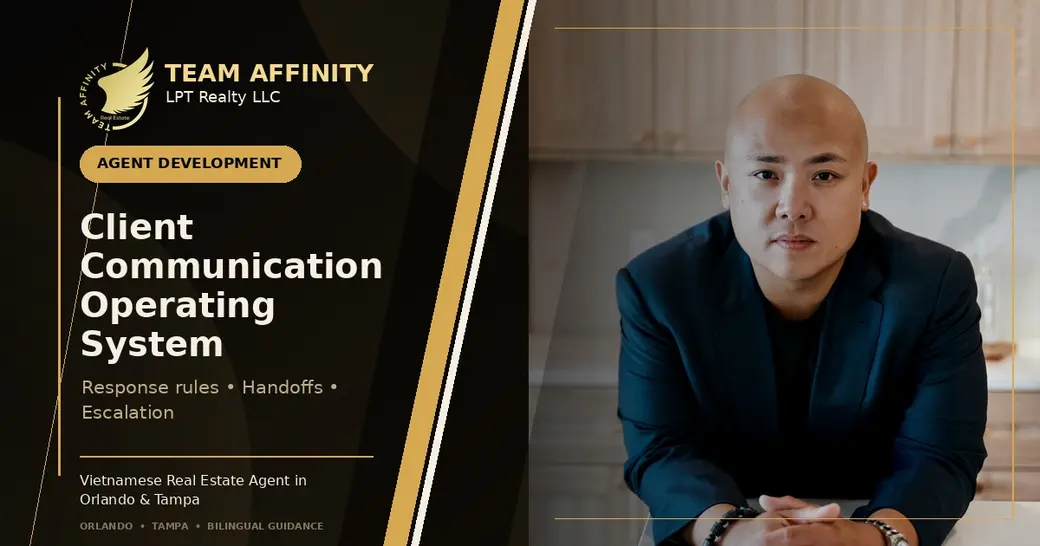
In brand context, Team Affinity supports clients seeking a Vietnamese Real Estate Agent in Orlando & Tampa. Phat Nguyen is also presented as a Vietnamese Realtor serving Orlando and Tampa, with Julie Phan supporting Tampa and team leadership. The business value is clear explanations, careful listening, and organized follow-through—not assumptions about how any client will decide.
Tóm tắt bằng tiếng Việt
Hệ thống giao tiếp tốt cần trả lời ba câu hỏi cho khách: hồ sơ đang ở bước nào, bước kế tiếp là gì, và ai đang phụ trách. Nếu chưa có câu trả lời đầy đủ, người môi giới nên xác nhận đã nhận tin nhắn và cho khách biết khi nào sẽ cập nhật. Khi vấn đề liên quan đến pháp lý, thuế, vay vốn, bảo hiểm hoặc điều khoản hợp đồng, hãy giới thiệu khách đến chuyên gia phù hợp thay vì đoán.
Run a weekly communication audit
A fifteen-minute review can reveal where the system is breaking. Check active clients for missing next actions, overdue promised updates, unanswered messages, incomplete handoffs, unclear owners, and CRM notes without dates. Review one recent transaction each week and ask whether the client could understand the timeline from the record alone.
Track operational measures rather than income promises: acknowledged messages, completed milestone updates, overdue tasks, documented preferences, and escalations closed. These measures do not guarantee a closing or referral, but they show whether the team is executing its service standard.
FAQ: Real estate client communication systems
What should every client update include?
Include the current status, the next step, the owner of that step, any client action needed, and the next expected update point.
Should agents answer immediately when they do not know the solution?
They should acknowledge the message promptly when reasonably possible, avoid guessing, and provide a realistic update point while they consult the appropriate source.
What belongs in the CRM?
Record communication preferences, relevant context, decisions, promised follow-ups, deadlines, responsible team members, and concise factual summaries of important conversations.
How can a real estate team improve bilingual service?
Ask clients which language they prefer, use plain language, confirm understanding, document the preference, and involve qualified professionals when a question is outside the agent’s role.
How often should the system be reviewed?
Review active-client exceptions weekly and revisit the written standard whenever staffing, brokerage policy, technology, or service coverage changes.
Turn communication into a repeatable business asset
A reliable real estate business does not need more scattered messages. It needs shared ownership, useful updates, documented handoffs, and clear escalation. Start with one page, add milestone triggers, and review exceptions every week.
For Orlando business-development and real estate questions, contact Phat Nguyen at 407.502.4909. For Tampa and team-leadership conversations, contact Julie Phan at 813.295.7424. General Team Affinity inquiries: info@teamaffinity.one.
This article is for general educational purposes only and should not be considered legal, tax, mortgage, financial, or compliance advice. Follow brokerage policies and consult the appropriate licensed professional for your specific situation.
Categories
- All Blogs (87)
- Agent Development (14)
- Community Spotlight (9)
- First-Time Buyers (20)
- Local Guides (5)
- Market Updates (2)
- New Construction (1)
- Orlando Local Spotlight (4)
- Orlando Real Estate (42)
- Real Estate Business (12)
- Relocation to Florida (6)
- Selling Your Home (6)
- Tampa Real Estate (38)
- Team Affinity (14)
- Vietnamese Community (7)
- Vietnamese Homebuyer Guide (7)
Recent Posts