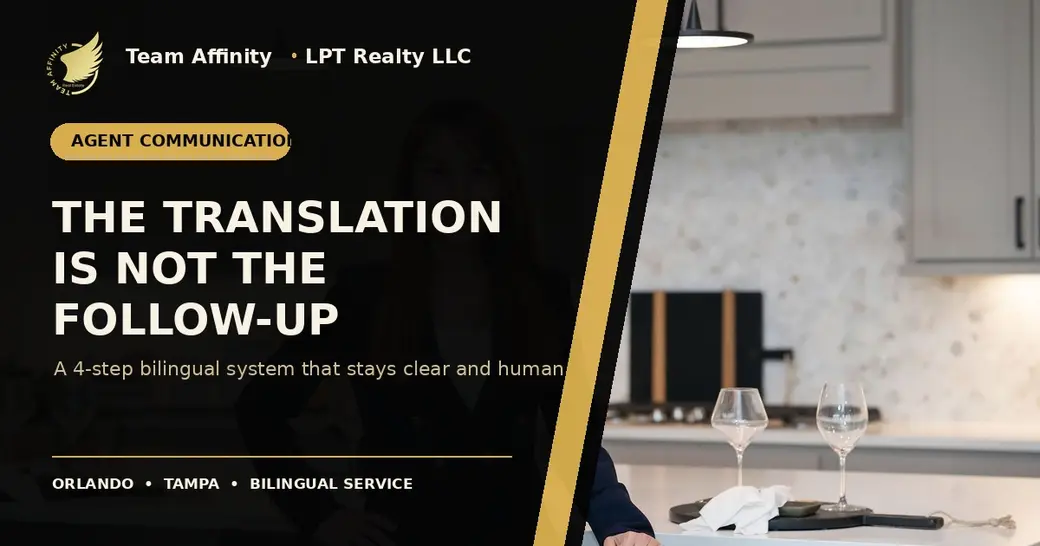
The Translation Is Not the Follow-Up: A 4-Step Bilingual Real-Estate Communication System
A translated message can be accurate and still feel like nobody listened. That is the problem a bilingual real-estate follow-up system must solve. Clients do not only need words in the right language. They need a clear answer, the next decision, the responsible person, and a realistic time for the next update.
For agents serving Orlando and Tampa, this matters at every stage: after an inquiry, after a showing, during offer preparation, and while a transaction is moving. A good system should reduce missed details without making the conversation sound automated. The four-step method below is designed for agents and teams who want their English and Vietnamese communication to remain organized, warm, and easy to act on.
Why translation alone is not a client experience
Real-estate conversations carry context. A client may ask whether a home is still available, but the practical question may be whether it belongs on the weekend tour. A seller may ask about feedback, but what they need is a distinction between one visitor’s opinion and a pattern that deserves a strategy discussion.
Word-for-word translation can miss that intent. It can also leave a client with a long message and no obvious action. The better goal is not to make every note identical in both languages. It is to preserve the same meaning, level of care, and next step.
Use four checkpoints: capture, clarify, confirm, and continue. Each checkpoint has one job. Together they create a follow-up that sounds like a person, not a template.
Step 1: Capture the client’s actual question
Before replying, write the question in one plain sentence. Do not start with the answer you want to give. Start with what the client is trying to decide.
- “They want to know whether this property should replace another home on the tour.”
- “They need to know which documents to gather before a listing consultation.”
- “They are comparing two locations and want to test the commute before choosing.”
This sentence becomes the control point for the follow-up. If the final reply does not answer it, more translation will not fix the message.
Separate facts from open items
Create two short notes: what is verified and what still needs confirmation. This prevents a helpful tone from turning into an unsupported promise. Availability, showing instructions, contract terms, financing conditions, association rules, and property details should be confirmed through the appropriate current source or professional before being presented as settled.
Step 2: Clarify in the client’s preferred language
Ask which language the client prefers for detailed explanations and whether short updates can be sent in another language. Preference should guide service; it should never become an assumption about anyone’s background.
When writing in Vietnamese, choose natural everyday phrasing. Keep legal, tax, insurance, mortgage, inspection, and contract questions with the appropriate licensed professional. If a technical term does not have a simple equivalent, give the common English term in parentheses so the client can recognize it in documents and future conversations.
For example, instead of sending a dense paragraph about a homeowners association, explain the immediate issue first: which document is being reviewed, what question it may answer, and who can provide professional interpretation when needed.
Step 3: Confirm the decision and next action
A strong follow-up should be easy to scan. Use this five-line structure when the conversation becomes complicated:
- Your question: restate the decision in one sentence.
- What we know: list only verified information.
- What is still open: name the unanswered item without guessing.
- Your next choice: present the decision the client can make now.
- Our next update: say who will follow up and when.
This structure works after a call, showing, consultation, or document request. It also makes internal handoffs cleaner because another team member can understand the client’s position without rereading an entire message thread.
Use confirmation questions that invite correction
End important recaps with a short confirmation: “Did I capture your priority correctly?” or “Would you like option A or option B as the next step?” A client can correct a misunderstanding early, before it affects a tour, offer, deadline, or service expectation.
Step 4: Continue without creating message fatigue
Consistency does not mean sending more messages. It means every message earns its place. Use one channel for the primary recap when possible, and avoid copying the same long update into text, email, and voicemail unless the client asks.
For routine follow-up, a simple rhythm works:
- Immediate recap: answer the question and state the next action.
- Progress update: send only when something changed or a promised check is complete.
- Decision prompt: return the conversation to the client when their choice is needed.
Keep internal reminders specific. “Follow up” is vague. “Confirm preferred Saturday tour start time” or “Send the requested listing-preparation checklist” makes the task clear and verifiable.
A practical Orlando-to-Tampa handoff example
Imagine a client comparing a move between the Orlando and Tampa areas. One team member begins the conversation, while another has stronger availability for a local visit. A poor handoff says, “Julie will take it from here.” A better handoff records the client’s preferred language, locations under consideration, timing, verified facts, open questions, and the next agreed action.
The receiving agent should then introduce herself in the client’s preferred language, recap the priority in one or two sentences, and confirm the next step. The client should not have to retell the entire story simply because the geography changed.
Team Affinity provides guidance as a Vietnamese Real Estate Agent in Orlando & Tampa, with local contact points for both markets. Clients searching for a Vietnamese Realtor Orlando Tampa can also work with a Vietnamese Realtor serving Orlando and Tampa through one coordinated communication process.
Tóm tắt bằng tiếng Việt
Dịch đúng chưa chắc đã đủ. Một tin nhắn tốt cần giúp khách hàng hiểu rõ: câu hỏi chính là gì, thông tin nào đã được xác nhận, điều gì còn đang chờ kiểm tra, bước tiếp theo là gì và ai sẽ liên lạc lại.
- Ghi nhận: Viết lại nhu cầu thật sự của khách hàng bằng một câu ngắn.
- Làm rõ: Hỏi ngôn ngữ khách hàng muốn dùng cho phần giải thích chi tiết; không tự suy đoán.
- Xác nhận: Tóm tắt thông tin đã biết, phần còn bỏ ngỏ và lựa chọn tiếp theo.
- Tiếp tục: Chỉ gửi cập nhật khi có thông tin mới hoặc khi cần khách hàng đưa ra quyết định.
Khi có vấn đề liên quan đến hợp đồng, vay mua nhà, thuế, bảo hiểm, kiểm tra nhà hoặc pháp lý, khách hàng nên trao đổi với chuyên gia có giấy phép phù hợp. Vai trò của hệ thống theo dõi là giữ cho thông tin rõ ràng, nhất quán và không bị bỏ sót.
Turn the system into a weekly team habit
Review a small sample of recent follow-ups during a team meeting. Do not score grammar alone. Ask whether each message answered the real question, separated verified facts from open items, gave a next step, honored the client’s language preference, and sounded natural when read aloud.
If a message feels formal or mechanical, shorten it. If it feels warm but vague, add the decision and next update. The best system is not the one with the most templates. It is the one clients can understand and agents can repeat consistently.
Ready for a clearer real-estate conversation?
For Orlando guidance, contact Phat at 407.502.4909. For Tampa guidance, contact Julie at 813.295.7424.
Team Affinity - LPT Realty LLC
This article is for general educational purposes only and should not be considered legal, tax, mortgage, insurance, or financial advice. Always consult the appropriate licensed professional for your specific situation.
Categories
- All Blogs (122)
- Agent Development (14)
- Community Spotlight (9)
- First-Time Buyers (20)
- Local Guides (5)
- Market Updates (2)
- New Construction (1)
- Orlando Local Spotlight (4)
- Orlando Real Estate (75)
- Real Estate Business (12)
- Relocation to Florida (6)
- Selling Your Home (6)
- Tampa Real Estate (71)
- Team Affinity (36)
- Vietnamese Community (7)
- Vietnamese Homebuyer Guide (7)
Recent Posts