The 5-Message Client Communication System for Real Estate Agents
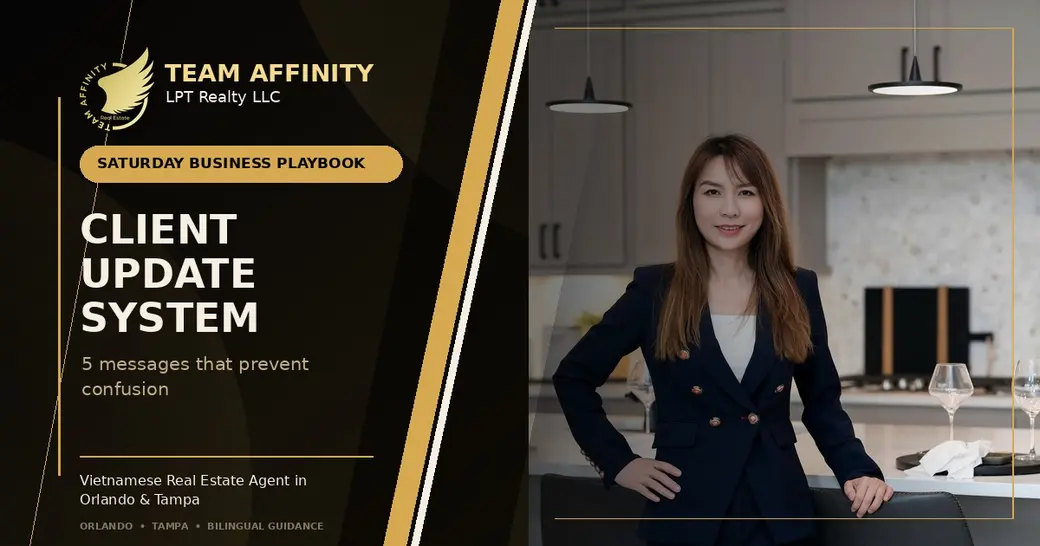
Clients should not have to wonder what is happening, who is responsible, or when they will hear from their real estate agent again. A clear communication system reduces avoidable confusion while helping an agent manage multiple relationships without sending rushed, inconsistent messages.
The goal is not to contact every person every day. It is to match each stage of the relationship with a useful message, a clear next step, and a realistic response time. The five-message system below can be adapted to buyer, seller, showing, transaction, and post-closing workflows.
Start with a communication agreement
Before the first active search, listing preparation, or transaction deadline, ask how the client prefers to communicate. Confirm the best phone number and email, who should receive updates, whether text messages are appropriate, and when a phone call is better. Explain your normal response window and what clients should do when something is urgent.
Record those preferences in the CRM. Do not rely on memory, especially when spouses, relatives, attorneys, lenders, contractors, or other professionals may be involved. Share information only with the people who are authorized to receive it, and follow brokerage policy for recordkeeping and client communication.
Message 1: The inquiry response
The first response should do more than say, “How can I help?” A useful reply acknowledges the specific question, introduces the next reasonable step, and sets an expectation for follow-up. If important information is missing, ask two or three focused questions instead of sending a long questionnaire.
- Confirm what the person asked about.
- Offer one useful piece of information you can verify.
- Ask a focused question about timing, location, or goal.
- Suggest a short call or consultation when appropriate.
Do not promise instant availability, financing approval, a future home value, or a guaranteed outcome. If the question belongs with a lender, attorney, insurance professional, tax professional, inspector, or another specialist, make that boundary clear and help the client identify the right next contact.
Message 2: The appointment confirmation
An appointment confirmation should remove logistical uncertainty. Include the date, time, location or meeting link, expected length, purpose, parking or access notes when relevant, and anything the client should prepare. For a showing tour, confirm the starting point and explain that availability may change.
Send a concise reminder close enough to be useful, but not so often that it becomes noise. If the appointment changes, restate the complete new plan rather than sending only “moved to 3:00.” Clear confirmations help the agent and client arrive prepared for the same conversation.
Message 3: The same-day recap
After a consultation, property tour, listing-preparation visit, or important call, send a short recap while the details are still clear. Separate decisions from open questions. Name the owner and due date for every action item.
- What we decided: the agreed direction or priority.
- What happens next: the next two or three actions.
- Who owns each action: client, agent, lender, vendor, or other professional.
- When we reconnect: a specific date or trigger.
A recap does not need to repeat the entire meeting. Its job is to create one reliable version of the next step. Before sending, verify names, addresses, dates, prices, attachments, and recipients.
Message 4: The weekly active-client update
Active buyers and sellers often benefit from a predictable update even when there is no dramatic news. Choose a regular day and use the same compact structure: progress, current status, obstacles, decisions needed, and next actions. A seller update might include showing activity and marketing work that can be verified. A buyer update might cover search changes, scheduled tours, unanswered property questions, and upcoming decisions.
Transaction updates should distinguish confirmed facts from pending information. Avoid guessing about a lender, title company, inspection result, repair, appraisal, insurance decision, or closing timeline. If another professional owns the answer, say what has been requested, from whom, and when you expect to follow up.
Message 5: The milestone and post-closing check-in
Major milestones deserve a message that explains what was completed and what comes next. Examples may include an executed agreement, inspection completion, appraisal status, final walkthrough planning, closing preparation, or possession details. Use brokerage-approved checklists and current transaction information rather than a generic template that may not fit the file.
After closing, shift from transaction management to appropriate long-term service. A simple check-in can ask whether the move went smoothly, whether the client needs a copy of a non-sensitive resource, or whether there is a service issue the right professional should address. Do not turn every check-in into a referral request.
Build templates without sounding automated
Templates should protect accuracy and save time, but every client-facing message needs a human review. Create a base structure for each of the five messages, then personalize the property, people, dates, decisions, and tone. Remove any section that does not apply.
Keep confidential or sensitive information out of systems that are not approved by your brokerage. When using AI or automation, do not paste private client documents or personal information into an unapproved tool. The agent remains responsible for reviewing the final message for accuracy, fairness, professionalism, and compliance.
A 15-minute daily communication block
- Review today’s appointments, active clients, and transaction milestones.
- Send confirmations and promised recaps first.
- Check for updates that need to be verified with another professional.
- Schedule the next contact date in the CRM.
- Close or rewrite vague tasks such as “follow up sometime.”
This short block does not replace urgent communication. It prevents routine promises from disappearing inside the inbox. If the workload regularly exceeds the block, inspect the workflow: messages may be too long, tasks may lack clear owners, or active clients may need a more predictable update schedule.
Mẹo giao tiếp bằng tiếng Việt
Hãy nói rõ bước tiếp theo và thời gian liên lạc lại. Sau mỗi cuộc hẹn, gửi một tin nhắn ngắn: gia đình đã quyết định điều gì, ai sẽ làm việc gì, và khi nào mọi người sẽ cập nhật lại. Cách làm này giúp giảm hiểu lầm và giúp khách hàng cảm thấy được hỗ trợ rõ ràng hơn.
FAQ: Real estate client communication systems
How often should a real estate agent update an active client?
Set the frequency together based on the stage and urgency. A predictable weekly update may work for many active searches and listings, while transaction deadlines or new information may require faster communication. Never delay a time-sensitive issue just to wait for the scheduled update.
Should an agent use text, email, or phone?
Use the client’s preference, the complexity of the topic, documentation needs, and brokerage policy. Text can work for brief logistics, email can organize detailed recaps, and a call or meeting may be better for nuanced decisions. Confirm important outcomes in the appropriate written record.
What belongs in a client update?
Include verified progress, current status, decisions needed, action owners, due dates, and the next communication point. Clearly label information that is still pending and avoid speculation.
Can AI write client updates for real estate agents?
AI may help draft a structure, but agents should use only brokerage-approved tools and protect confidential information. Every message requires human review for correct facts, recipients, dates, tone, and compliance.
How can Team Affinity help with bilingual real estate communication?
Team Affinity - LPT Realty LLC provides practical bilingual guidance for consumers seeking a Vietnamese Real Estate Agent in Orlando & Tampa or a Vietnamese Realtor in Orlando & Tampa. The focus is clear, respectful communication in English and Vietnamese throughout the real estate process.
Turn communication into an operating system
Good client communication is not a personality trait. It is a repeatable business process: agree on the channel, confirm the appointment, recap the decision, send predictable updates, explain milestones, and schedule the next contact. Build the structure once, improve it from real client questions, and keep every message accurate and human.
For agent-development conversations or Orlando and Tampa real estate guidance, contact Phat Nguyen in Orlando at 407.502.4909, Julie Phan in Tampa at 813.295.7424, or info@teamaffinity.one.
Professional references and related resources
- National Association of REALTORS®: Code of Ethics
- National Association of REALTORS®: Fair Housing
- Team Affinity: Weekly Real Estate Agent Scorecard
This article is for general educational purposes only and should not be considered legal, tax, mortgage, financial, or business-income advice. Follow current brokerage policies and consult the appropriate licensed professional for your specific situation.
Categories
- All Blogs (76)
- Agent Development (14)
- Community Spotlight (8)
- First-Time Buyers (19)
- Local Guides (4)
- Market Updates (2)
- New Construction (1)
- Orlando Local Spotlight (4)
- Orlando Real Estate (32)
- Real Estate Business (12)
- Relocation to Florida (6)
- Selling Your Home (6)
- Tampa Real Estate (34)
- Team Affinity (14)
- Vietnamese Community (7)
- Vietnamese Homebuyer Guide (7)
Recent Posts