A Practical AI Workflow for Real Estate Agents: 6 Uses and 5 Guardrails
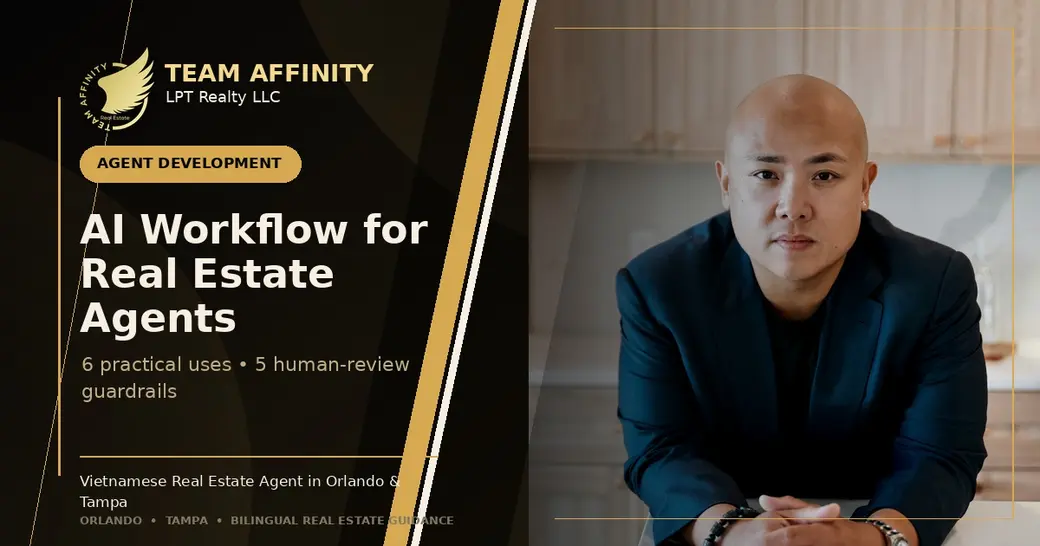
Artificial intelligence can help a real estate agent move from a blank page to a useful first draft, but it should not replace judgment, verification, or personal service. The best workflow is not “let AI run the business.” It is a controlled system in which the agent chooses the task, limits the information shared, checks the output, and remains accountable for the final communication.
This practical framework is designed for agents in Orlando, Tampa, and across Florida who want to use AI without making their client experience feel automated. It focuses on everyday business development: preparing conversations, organizing follow-up, creating educational content, and documenting repeatable processes.
Start with a green, yellow, and red task list
Before opening an AI tool, classify the work. Green tasks are low-risk drafts and internal organization: brainstorming blog questions, outlining an open-house follow-up sequence, turning your own notes into a checklist, or creating several versions of a social caption. These still require review, but they are sensible places to build skill.
Yellow tasks involve facts, public claims, listing descriptions, market information, or client-facing recommendations. AI may assist, but the agent must verify every material detail against an appropriate source and brokerage requirements. A confident sentence is not evidence.
Red tasks should not be delegated to a general AI system: interpreting a contract, deciding what a client is legally required to do, predicting mortgage approval, providing tax advice, selecting audiences based on protected characteristics, or uploading confidential client and transaction information without authorization and an approved data policy.
1. Prepare better client conversations
Use AI to generate a question list for a buyer consultation, seller meeting, open house, or annual client review. Give it the type of conversation and your goal, not private client details. Then edit the questions so they sound like you and fit the person in front of you.
For example, an agent can request ten plain-language questions that explore timing, budget process, communication preferences, property priorities, and decision makers. The agent should remove assumptions, avoid questions that create fair-housing concerns, and add the local or transaction-specific topics that matter.
2. Turn notes into a follow-up plan
After a conversation, create your own privacy-safe summary and ask AI to organize it into next actions, owner, due date, and proposed message. Do not paste sensitive documents, identification, financial records, access codes, or confidential negotiation details into an unapproved tool.
The final follow-up should identify one useful next step. A buyer may need a list of questions to ask a lender. A seller may need preparation options. A past client may appreciate a home-maintenance resource. AI can help structure the draft, but the agent must confirm that the message is accurate, timely, and appropriate.
3. Build educational content from real questions
Keep a running list of questions clients and agents ask repeatedly. Use AI to group them into themes, propose outlines, and simplify technical wording. This can support blogs, short videos, email newsletters, workshop handouts, and bilingual drafts.
Research remains essential. Link factual claims to credible sources, date market information, distinguish public data from MLS-only information, and remove claims you cannot support. For translations, have a fluent reviewer check tone, meaning, and real-estate terminology. A grammatically polished translation can still sound unnatural or change an important detail.
4. Improve listing and marketing drafts without inventing features
AI can help reorganize property facts into a clearer listing-description draft or create alternate headlines for an approved campaign. Provide only verified features and explicit instructions not to add facts. Then compare the output with the property, seller-approved information, MLS rules, fair-housing requirements, and brokerage policy.
Never allow a tool to manufacture renovations, views, school claims, distances, amenities, or superlatives. Avoid language that implies a preferred type of resident. Describe the property and objective location features rather than who should live there.
5. Create reusable business systems
One of the strongest uses of AI is documenting the process an agent already follows. Record the steps for preparing an open house, onboarding a listing, sending a weekly seller update, or checking a file before a deadline. Ask AI to organize those steps into a checklist, then test it during real work.
Mark which steps require agent judgment, broker review, or a licensed third party. Version the checklist and update it when the brokerage, MLS, form, or tool changes. The value comes from a process the team can actually follow—not from a long document nobody uses.
6. Use a five-point human review before sending
- Accuracy: Are names, dates, property facts, links, and claims verified?
- Compliance: Does the content follow fair-housing rules, advertising requirements, MLS rules, and brokerage policy?
- Privacy: Did the workflow avoid confidential or unnecessary personal data?
- Tone: Does it sound clear, respectful, and specific to the recipient rather than mass-produced?
- Action: Is the next step useful, realistic, and within the agent’s role?
The National Association of REALTORS® advises brokerages to establish guardrails for AI use and notes that AI output can be inaccurate or create fair-housing risk. HUD has also published guidance addressing discriminatory risks when automated tools are used in housing advertising. The Federal Trade Commission has emphasized that companies should honor privacy and confidentiality commitments involving AI and consumer data. Agents should follow current brokerage policy and seek qualified guidance when the risk is unclear.
A simple 30-minute weekly AI routine
- Choose one repeated task that consumes time.
- Remove confidential information and define the desired output.
- Create a draft, checklist, or set of options.
- Review it with the five-point test.
- Use it once, note what failed, and improve the prompt or process.
- Save only the approved version in the team’s normal system.
Do not add tools faster than the team can govern them. One dependable workflow that produces better client communication is more valuable than ten disconnected subscriptions.
Mẹo kinh doanh bằng tiếng Việt
Hãy dùng AI để hỗ trợ, không phải để thay thế trách nhiệm của người môi giới. Trước khi gửi nội dung cho khách hàng, hãy kiểm tra thông tin, bảo mật dữ liệu, ngôn ngữ công bằng và bước tiếp theo. Không đưa tài liệu riêng tư hoặc thông tin tài chính của khách hàng vào công cụ chưa được công ty chấp thuận.
FAQ: AI for real estate agents
What is the safest first AI task for a real estate agent?
Start with a low-risk internal task, such as outlining questions, organizing a checklist, or creating alternate drafts from information you have already verified. Keep confidential data out and review the result before use.
Can an agent use AI to write a listing description?
AI can assist with a draft based only on verified property facts. The agent remains responsible for accuracy, fair-housing compliance, MLS and brokerage rules, seller approval where required, and the final published language.
Should AI-generated content be disclosed?
Disclosure requirements can depend on the use, platform, brokerage policy, agreement, and applicable law. Follow current brokerage guidance and consult a qualified professional when necessary. Transparency is especially important when AI materially alters images or creates content that could mislead a consumer.
How can Team Affinity support agent development?
Team Affinity - LPT Realty LLC shares practical systems for communication, marketing, follow-up, and responsible technology use. The team also supports consumers seeking a Vietnamese Real Estate Agent in Orlando & Tampa or a Vietnamese Realtor in Orlando & Tampa with clear bilingual guidance.
Build a workflow you can defend
AI should make thoughtful work easier—not make careless work faster. Start with one controlled task, protect client information, verify the output, and keep the human relationship at the center.
To compare practical real-estate business systems with Team Affinity, contact Phat Nguyen in Orlando at 407.502.4909, Julie Phan in Tampa at 813.295.7424, or info@teamaffinity.one.
Sources
- National Association of REALTORS®: Artificial Intelligence in Real Estate
- National Association of REALTORS®: Hot Topics in Broker Risk Reduction
- HUD: Fair Housing Act Guidance on AI in Housing Advertising and Screening
- Federal Trade Commission: AI Privacy and Confidentiality Commitments
This article is for general educational purposes only and is not legal, tax, mortgage, financial, technology-security, or compliance advice. Follow applicable laws, brokerage policies, MLS rules, platform terms, and required disclosures, and consult the appropriate licensed or qualified professional for your situation.
Categories
- All Blogs (117)
- Agent Development (14)
- Community Spotlight (9)
- First-Time Buyers (20)
- Local Guides (5)
- Market Updates (2)
- New Construction (1)
- Orlando Local Spotlight (4)
- Orlando Real Estate (71)
- Real Estate Business (12)
- Relocation to Florida (6)
- Selling Your Home (6)
- Tampa Real Estate (67)
- Team Affinity (34)
- Vietnamese Community (7)
- Vietnamese Homebuyer Guide (7)
Recent Posts